
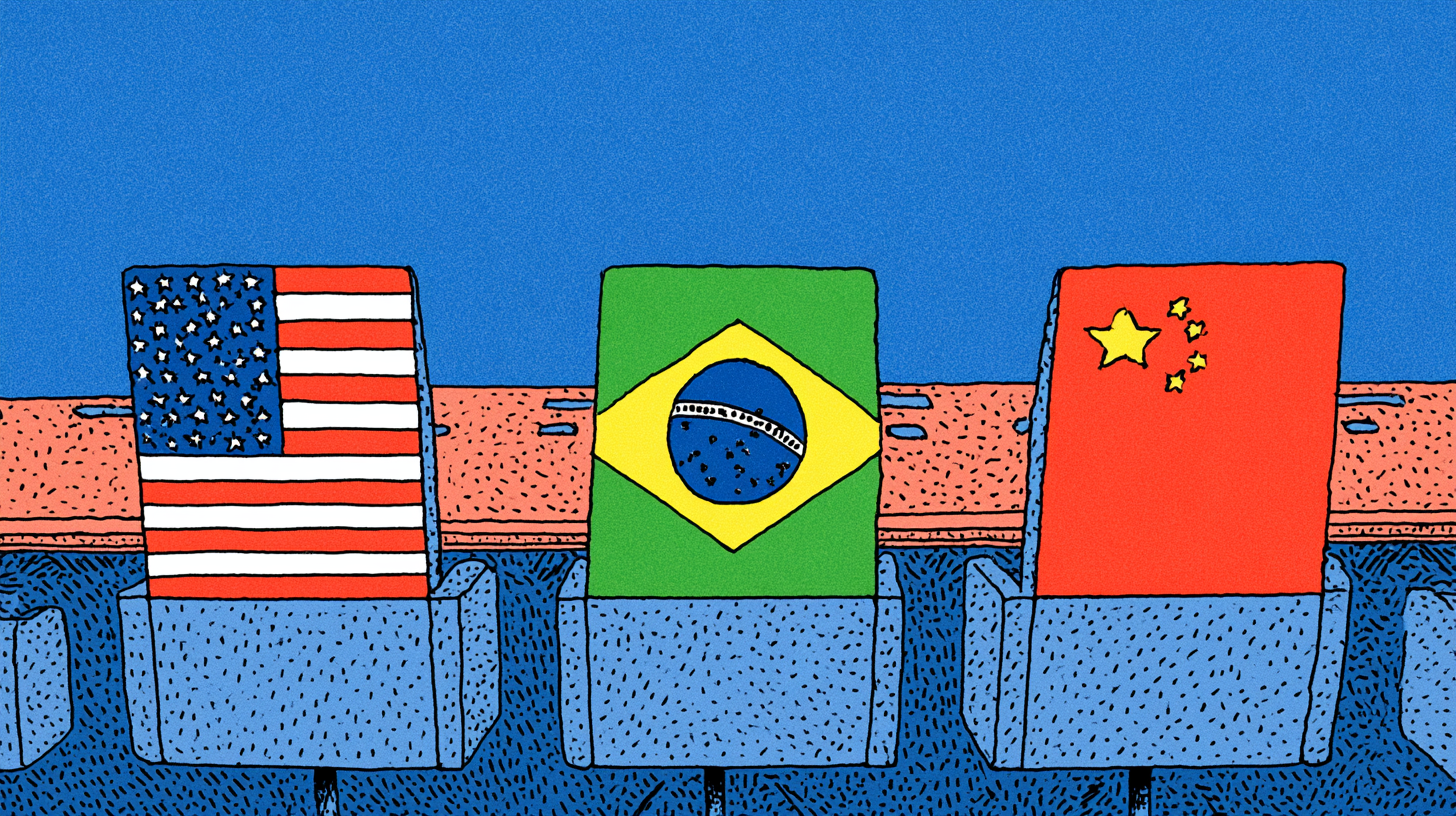
Late on a Sunday in July, Brazil’s Luiz Inácio Lula da Silva and China’s Xi Jinping stayed on the phone for more than an hour. The mood was warm, a little triumphant. The two governments said they wanted to speed up a China–Mercosur trade deal that had been stuck for years. They also talked satellites, processing critical minerals, and dropping short-stay visa rules.
For Brasília, that is not a tweak. It is a U-turn. For a long time Brazil was the country inside Mercosur that most wanted this kind of China deal kept in a drawer. Then, in about two weeks, the drawer opened. Jake Scott, writing at FEE, traces the flip to a new round of American tariffs — and to Lula’s conclusion that lining up with Washington had finally started to cost more than it paid.
An old Brazilian habit with a new name
Brazil is not answering the United States with a matching punch, and it is not folding. It is spreading risk on several fronts at once. Commentators like to call that a rational move in a “multipolar” world. Brazilians had a plainer phrase for it almost a century ago: pragmatic equidistance. Keep the great powers close enough to be useful, far enough that you do not belong to any of them.
The spark this time is a widening tariff fight. In late July a 25 percent U.S. tariff landed on a broad slice of Brazilian goods. Industry groups in Brazil say nearly half of what the country sells to the United States now faces some extra duty. On top of that, Washington added a 12.5 percent “forced-labor” levy — a way of exporting America’s existing ban on goods tied to forced labor, including from China. On the hardest-hit products, the combined hit is about 37.5 percent.
Lula’s public line is that this is Washington’s mistake, not Brazil’s. In the Washington Post he called the tariffs a “strategic mistake” and warned that Brazilian firms would start swapping American suppliers for someone else. He also sent the dispute to the World Trade Organization, arguing that both the broad tariffs and the forced-labor levy break the 1994 GATT rules. Nobody pretends the WTO is a sharp tool right now. Filing there while still talking to the United States is the point: complain, negotiate, and shop around, all at the same time.
New markets, old election calendar
The shopping is already funded. ApexBrasil, the country’s trade-promotion agency, rolled out a program worth about R$105 million (roughly $20.5 million) to help nearly 2,500 exporters in 57 industries find buyers in the EU, Southeast Asia, and Central Asia. Mercosur, with Brazil in the lead, is chasing parallel talks with India, Japan, and Canada. Lula has put the Mercosur–Singapore agreement into force — the bloc’s first with a Southeast Asian economy — so Brazilian goods can move toward duty-free entry there.
At home, the tariffs have been a political gift. Plenty of Brazilians read them as an attempt to lean on the October 2026 election. That lets Lula play the sovereignty card. It is working on the numbers Scott cites: Lula has held in the mid-40s, while Flávio Bolsonaro, the other serious contender, has been sliding since April. The gap has widened.
Bolsonaro did not help himself by launching his bid flanked by Javier Milei and Benjamin Netanyahu, with few Brazilian politicians in the room. In a country already twitchy about foreign hands on the scale, that photo looked tone-deaf — especially with Argentina and Brazil on worse terms. When the United States sent election officials to inspect Brazil’s voting system, Brasília simply refused the visas. For voters who hate the feeling of being managed from abroad, the message landed.
China was always the larger door
The bigger hedge is China, and Mercosur makes that messy. It is a customs union, so members are supposed to negotiate together. A China deal has been “under study” since around 2017. Uruguay pushed. Brazil hit the brakes. In January 2023 Lula even went to Montevideo to argue that Mercosur should lock in Europe first and only then sit down with Beijing.
That European deal finally got signed in Asunción in January 2026 — after 26 years — and took effect in Brazil in April. On Brasília’s side, the old excuse is gone. On Argentina’s side, Milei is still ideologically hostile to China and can still veto a Mercosur pact. Even without a new treaty, China is already Brazil’s largest trading partner, with about $188 billion in two-way commerce. A formal deal would mainly widen the farm gate and lock in a partner Brazil is already living with.
Scott’s close is unsentimental. Brazil is not picking a bloc. It is keeping options open while the old North Atlantic habit gets more expensive. Over a long enough stretch, that may be the least naive move in the room.
Source: FEE, Jake Scott
 0.000 SRY