

Four Forms of Numericide by Alan Cassels at Brownstone Institute
A recent article in the New York Times on the increasing rates of heart disease in young women (Why Are More Young Women Developing Heart Disease?) was amusingly frivolous and about as fact-free as an article about health advice can be.
The key thrust of the article is that any woman who wants to preserve and improve her health should become informed of her “numbers.” Which is to say, she should know her blood pressure, cholesterol, BMI, and hemoglobin A1C (a measure of average blood glucose levels) which are claimed to be “important for assessing risk.”
The Times quotes Dr Priya Freaney, director of the Women’s Heart Care program at Northwestern Medicine: “Knowing your numbers is your most powerful tool,” [she said] “And it’s never too early to start.”
What numbers are we talking about? Well, apparently doctors recommend “all adults strive for these levels:”
BP (Blood Pressure) under 120 mm Hg / 80 mm Hg
LDL (Low-density lipoprotein) under 100 mg/dL
HbA1C (Hemoglobin A1C ) of 5.6 or lower
BMI (Body-mass index) under 25
Now the four Horsemen of the Apocalypse, blood pressure, blood sugar, cholesterol, and BMI, threatening to strike you down in your healthy middle age unless you submit to the testing, treating (ie: medications and lifestyle changes), and a retesting paradigm which can lead many to become obsessed by the numbers.
By the way, these four measures have one thing in common: They are typically treated with a prescribing pen that has been carefully guided in your doctor’s expert hands by the helpful people in the pharmaceutical industry. Just saying…
Let’s approach these four with a bit of basic epidemiology, examining the wisdom of telling people of “average risk” to aim for these targets. Obviously, people with pre-existing conditions or those with inherently much higher or multiple risks (such as levels that are in the red flashing light category) involve a different calculus.
But for the sake of evaluating the drive to push people toward these health targets, what do the highest quality studies ultimately say about the value in chasing these numeric targets in healthy people?
Numericide Number One: Blood Pressure at 120/80
I will always remember that old quip from an aging physician: “High blood pressure is better than no blood pressure at all.” But the question one should ask is this: If you lower your blood pressure does it lead to a reduction in your chance of a cardiovascular event or dying?
First off, despite what many guidelines and health care providers say about knowing your numbers, what they should have said was know your cardiovascular risk numbers (your percentage chance of having a heart attack or stroke over the next 10-30 years) not your numbers of cholesterol, blood pressure, or glucose numbers. Those are what we call ‘surrogate markers’ and the only reason to lower these numbers is to possibly reduce your risk of heart attacks and stroke. It’s not that these surrogate numbers are useless — rather they are the wrong numbers to worry about. Their only use is to help us give a more accurate ballpark assessment of your cardiovascular risk.
For starters, the target of 120 is not an evidence-based but an “expert-recommended” target, and in case you wondered, having a blood pressure of 130/80 or 140/90 is not the death sentence that your doctor might warn you about. Your blood pressure often jumps all over the map and how and when you measure it can significantly impact that number. It climbs as we get older, naturally. Like grey hair and wrinkles. Chasing this number is one of the biggest uses of a doctor’s time and causes considerable (and frequently unnecessary) worry in patients.
Me? I wish our doctors would have spent time learning more about evidence appraisal and how to properly do shared decision-making with their patients because the decision around the treatment of surrogate numbers is very dependent on a person’s values and preferences. Cholesterol or blood pressure “management” makes a ton of money for the pharmaceutical industry and seems like a good use of our doctors’ time, but often causes a lot of harm in a large part of the otherwise healthy patient population.
The magical “120” comes from the SPRINT trial, a particularly odious piece of work that tortured the data until it showed some benefit of a BP <120 comparted to divergent targets such as <140 in a high-risk population. What most physicians aren’t going to learn is that any apparent benefit evaporated once intensive treatment stopped.
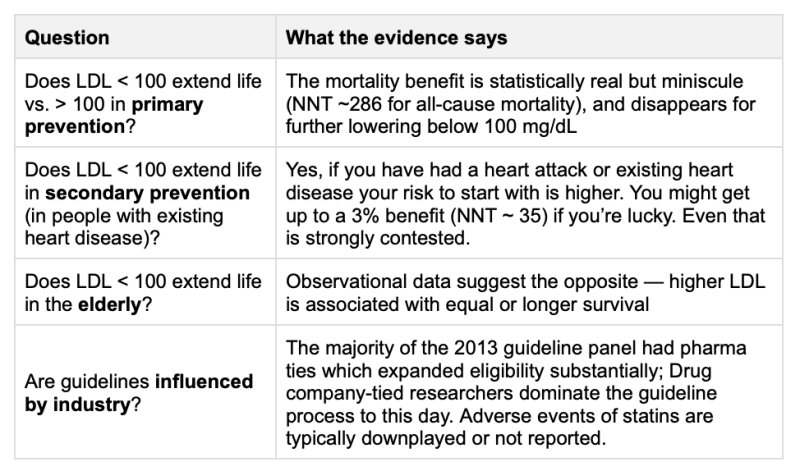
The SPRINT team was behind the 2017 guidelines recommending the 120/80 BP target, but you need to know these guidelines have been discredited for good reason. For instance, the process to produce them was riven with documented conflicts of interest. Again, Big Pharma’s interests are more than well-represented on the guideline production team and their participation automatically broadens the category of people who should take their drug. No — surely that can’t be true? It is true, and to quote a refrain from the movie Airplane, stop calling me Shirley.
The AAFP, American Association of Family Practice— the largest primary care organization in the US — refused to endorse that target. Why? Because, in their words, there were “no significant benefit for all-cause mortality, cardiovascular mortality, myocardial infarction, or renal events.” Let me translate: People don’t live longer or better because you guilt-tripped and drug-equipped them into getting their blood pressure down to 120/80.
There’s also another reason and that has to do with how unsafe it can be to push people’s blood pressure to ridiculously low targets. Not only does this drive people crazy (because many of them have to take two or three or four medications to lower their BP numbers) but it can also lead to falls, fractures, kidney injury, and so on, especially in older adults.
One study in JAMA Internal Medicine found that taking antihypertensive medications was associated with an increased risk of serious fall injuries. SPRINT itself showed nearly double the rate of serious adverse events possibly or definitely related to the antihypertensive drugs.
Like any two-edged sword, drugs to lower your blood pressure can also cause injury to you in ways you haven’t yet foreseen and which could make your life miserable.
Numericide’s Number Two: Low-Density Lipoprotein, or LDL, under 100 mg/dL
This is one of the most aggressively, and irrationally pursued targets: LDL cholesterol. I went back into the data to ask this question: Is there any substantive evidence that an otherwise healthy person with an LDL under 100 mg/dL lives any longer than a person who has an LDL above 100mg/dl?
Basically, should healthy people (what we call ‘primary prevention’) who don’t have a history of a heart attack or heart disease be pushed to get their LDL from, say, 120 to 80 mg/dL? Will this make them live longer?
Sorry to be the bad news bear here, but in a nutshell: No.
The evidence is weak and the absolute benefit is very small. When I mean very small, it’s way smaller than most people expect.
The most comprehensive recent review was published in JAMA in 2022. It was huge, pooling 18 trials of statins for primary prevention including over 85,000 people. The rate of all-cause mortality was statistically significant yet the absolute difference between those who drove their cholesterol that low and those who didn’t was a meagre 0.35%.
The NNT (number needed to treat to prevent one death) was 286.
Another way to say this is that your chance of a normal healthy person dying if they take a statin to drive their LDL below the 100mg/dl target is almost one in 300. Others have strongly contested this number, saying that driving cholesterol down to those levels makes absolutely no difference to the length and quality of a person’s life.
What about older people? You’re in for a surprise here—because in the elderly the situation reverses. A study published in the BMJ in 2016 identified LDL-related studies in the elderly. It found that in a total of over 68,000 elderly people, there was an “inverse association between all-cause mortality and LDL.” Translation: older people with higher LDL levels lived longer! This makes it even more egregious that much of the population taking cholesterol-lowering drugs are over 65 and in the category where they actually need higher cholesterol to stay healthy.
And then there are the harms of cholesterol lowering drugs, like statins which we know cause muscle weakening, elevated liver enzymes, and diabetes, effects that are consistent across many studies.
Doctors know this from real life experience: most patients (up to 75%) stop taking their statins within 2 years — whether it’s from the adverse effects, the costs or the hassle.
Numericide’s Number Three: HbA1C (Hemoglobin A1C ) of 5.6 or Lower
The crazy low levels at which they tell people to drive their HbA1C down to make me bonkers. What is most nutty is that this nefarious hunt for “prediabetes” which is the granddaddy of all disease-mongering tactics is sold under the logic of ”Why wait until you have full blown diabetes when you can find the ‘pre’ signs early?”
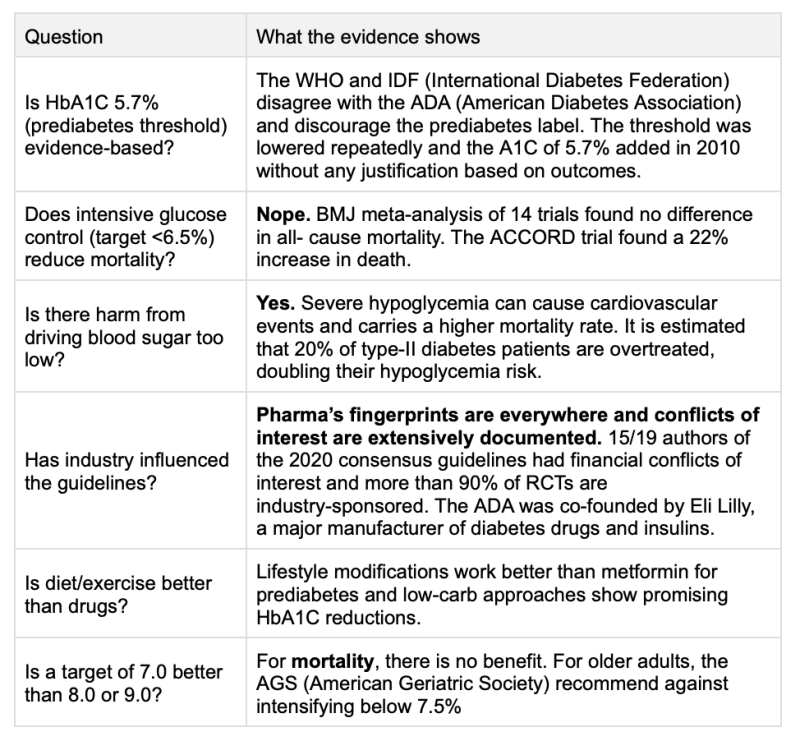
To be clear, the 5.6% is not a treatment target — it's the “prediabetes diagnostic threshold.” In the ever-reductive world of diabetes “normal” keeps shifting. “Normal” is now considered below 5.7%, prediabetes is 5.7–6.4%, and diabetes is diagnosed at ≥6.5%.
The actual treatment target for most adults with diabetes is <7.0%, a level that sadly labels tens of millions of healthy people as diseased. If you have an HbA1C slightly over 7 and your doctor is pushing a metformin prescription at you, it’s time to push back!
Here’s the core point: the evidence does not support that driving HbA1C to 6.5% or lower extends life. The best available data from two big studies — the ACCORD trial and a meta-analysis from the BMJ — show two very surprising things: either no mortality benefit or actual harm from intensive glucose control.
Just to repeat: You do not live longer if you drive your HbA1C into the basement.
Furthermore, there is the opposite thing that could harm you, hypoglycemia — which is often caused by aggressive drug treatment is, in itself, a potent killer.
Just remember that these thresholds are always changed in a uni-directional way, always made lower to expand the pool of patients who allegedly need to be on drugs. This is a process that takes place under the well-documented influence of pharma money, research, and experts, expanding the market for diabetes drugs at each step.
The major push to label people as “prediabetic” — a condition that, incidentally the WHO says shouldn't be medicalized — is flat-out, brazen disease-mongering.
Having said that, extremely high blood sugar (HbA1C consistently above 9–10%) can cause real harm — kidney failure, blindness, neuropathy, infections. The point isn’t that glucose doesn't matter at all; it's that the marginal benefit of pushing from 7.0 to 6.5% or lower does not save lives, and the harm, both in terms of money, medical busy-ness of checking and rechecking your blood sugars, and the harms of the drugs are all real and quantifiable.
Eating a higher quality diet and getting sufficient exercise is the foundation for anyone worried about their blood sugars. Those who are told they have “pre-diabetes” should ignore that advice and refuse to be pasted with a sticky label that causes harm.
Numericide’s Number Four: BMI under 25
Body Mass Index (BMI) is a measure of body weight relative to height, often used to screen whether someone may be underweight, at a healthy weight, overweight, or obese. We need to screen because overweight people live shorter lives, right?
Not necessarily.
We are told that the aim for everyone, concerning this fourth Horseman of the Apocalypse, BMI, is 25. Not only is this absurdly low, but it is essentially meaningless as a measure of health on its own. Anyone with any good musculature whatsoever is going to have a BMI over 25. Why is that? Because muscle weighs more than fat.
It comes down to where the weight sits. A muscular person with BMI of 30 has a different risk profile than a guy with a BMI of 30 who is sedentary with a big beer gut — but the BMI treats them identically.
Where did this “25” come from?
The BMI 25 cutoff comes from a 1995 WHO technical report establishing four categories of body weight (underweight, normal, overweight, obese) and was loosely based on actuarial life insurance data. This threshold was not derived from outcome-based evidence and a BMI of 25 was not linked to any mortality inflection point.
What about someone who has, say, a BMI of 30. Should they get that lower?
The claim that someone at BMI of 30 has a meaningfully shorter life expectancy than someone at BMI of 25 is not supported by the best available observational evidence.
The largest and most influential meta-analysis on this question was published in JAMA in 2013 and it pooled 97 studies with over 2.88 million participants and more than 270,000 deaths. The findings were mind-blowing: Being overweight was associated with significantly lower all-cause mortality than normal weight. In fact, what is called “Grade 1 obesity” (BMI ~30) showed no significant increase in mortality. Only at BMI ≥35 did mortality clearly rise.
Let me translate: Being “kind of chubby” which would describe almost everyone my age, (mid-60s) is not the death sentence they say it is.
In other words, pushing people to have lower and lower BMIs has very little to do with their overall health.
As I have written before, the enthusiasm for high-priced weight loss drugs (see my past articles on GLP-1 drugs here, here, or here) is skewing medicine in a decidedly dark way. The financial machinery behind the current obesity treatment paradigm is putting whole generations of people on drugs that will deliver almost no meaningful impact on the length or quality of their lives. And the conflicted interests in obesity research and advocacy is documented to a degree that makes the cholesterol and blood pressure guideline conflicts look modest by comparison.
So there we have it, four targets — blood pressure, blood sugar, cholesterol, and BMI — the Four Horsemen of the Apocalypse, four ways to medicalize you, four ways to apply a disease-mongered label to you, and four avenues for you to start living under a dark cloud.
I say, reject all that.
Is “knowing your numbers” a powerful tool, as the experts suggest?
I guess it is, only if you want to fast-track yourself to being a patient. If your doctor is interested in your opinion and subscribes to the school known as “shared decision-making” then let your opinions be known.
At the end of the day don’t let anyone make you feel like you’re living under a dark cloud of impending doom because your numbers are slightly higher than what the experts recommend.
Four Forms of Numericide by Alan Cassels at Brownstone Institute - Economics, Policy, Public Health, Education, Society
Original Author: Alan Cassels | Source: Brownstone Institute
 532.526 SRY