

What Would a Brutally Honest Man Look Like?
by Filipe Rafaeli at Brownstone Institute
Diogenes was one of the most iconic philosophers of ancient Greece. He roamed the streets of Athens in broad daylight carrying a lit lantern. When asked why he was performing such an unusual scene, Diogenes would reply that he was looking for an honest man. He never found one.
More than two thousand years later, Diogenes’ questioning remains just as valid and relevant as much of the teachings of the ancient Greek philosophers. Recently, I was reminded of him when I came across an analysis by a columnist in one of Brazil's largest newspapers. This analysis, which addresses the effectiveness of ivermectin during the pandemic, resurfaced when the pandemic returned to the headlines following the revelations from Anthony Fauci's diary—the czar of the US government's Covid-19 response.
In fact, given the accumulation of evidence since the very beginning of the Covid-19 drama, along with the facts that have been laid out and the proven lies that have slowly come to light, I began to wonder what a truly honest person would say today about this period in history. In this article, I propose to carry out this exercise. But first, let's delve a little into the context.
Drugs for Covid-19
In theory, I wouldn't even need to introduce the subject much. Any human being who lived through the pandemic and at least skimmed the news knows that the proposals for hydroxychloroquine and ivermectin against Covid came to nothing. They started out as scientific possibilities, as hopes. But they were quickly dismissed by the authorities. After that, those who talked about the subject were treated as "conspiracy theorists." Those who continued to insist later became the subject of studies on health disinformation or political extremism.
The situation was so serious that even doctors—even after regulatory agencies like the WHO strongly recommended against it—continued prescribing it for Covid-19 to their patients. Some were fined, others lost their licenses to practice medicine. At this point, after everything had been so thoroughly clarified, the subject shifted to a different level: it ceased to be science and became fodder for comedians.
When a subject becomes fodder for comedians, that is the pinnacle of a society's consolidated knowledge. It means you can no longer have a serious conversation with the few stragglers still repeating such nonsense. All that's left to do is make jokes. One example is the Brazilian comedian and influencer Maria Bopp, who has over 1 million followers on Instagram. She produced a samba. The lyrics talk about people who deny science, such as those who believe the Earth is flat. This is just one example among several comedy sketches, political cartoons, and jokes.
The same thing happened in the US. Forbes ran a story about those who used humor to combat the disinformation surrounding ivermectin as a solution for Covid-19. Television comedians took aim at both medications. The overall tone was one of mockery.
Chloroquine and Hydroxychloroquine
Before I talk about the text by columnist Frankito (Franklin Weise), who defines himself as a data analyst, in the newspaper O Estado de S. Paulo, where he addresses ivermectin, let me talk a bit about chloroquine and its slightly younger, yet septuagenarian, sister, hydroxychloroquine.
We are in 2026. Today, we open the University of Oxford website. On the site, we find a published news piece: "Hydroxychloroquine provides moderate COVID-19 prevention, large clinical trial shows." In other words, the subject was the butt of jokes, synonymous with crazy people across all media, yet it is reported as effective on the website of the university that, in any serious ranking, is placed among the first, second, or third in teaching quality and scientific output. Oxford, depending on the year, rivals Harvard and MIT in the rankings.
I wanted to go straight to Frankito's text, or already carry out the exercise of the "brutally honest man" with you, the reader, but I need to explain a little about this news on the Oxford website. It is necessary. The contrast between the subject being a mockery and then reading this news from the university that represents the world bastion of science and rationality is, you will agree, immense.
It only became news on the Oxford website because HCQ against Covid reached the highest level of scientific evidence a drug can attain. In addition to their clinical trial, the "gold standard," on the use of hydroxychloroquine in pre-exposure prophylaxis, Oxford conducted a meta-analysis, bringing together all previous studies on the use of the drug in this context, also a "gold standard." Pre-exposure prophylaxis is when you take the medication before coming into contact with the virus, to reduce or eliminate your chances of contracting it.
Precisely because it is the highest level of evidence, Oxford put its foot down and reported in the news piece that it is effective, leaving no room for doubt. For reference, 91% of standard cardiology treatments do not possess this highest level of evidence (meta-analysis of multiple RCTs – randomized controlled trials). In other words, HCQ against Covid belongs to the select group of the most thoroughly proven drugs in existence. Furthermore, the study wasn't just published. Oxford published the study and issued a news piece on its website, giving the institution's unequivocal endorsement. People cannot try to move the goalposts with the idiotic argument that it's "not an Oxford study, but a study by Oxford researchers."
The meta-analysis showed 20% efficacy. But even so, some questions remain. Why did it take over two years to publish the results? Yes, the study sat in a drawer for two years. Why the rush during a pandemic? The second question is: why, in the middle of the study, did they change the endpoint to seroconversion? The vaccine studies did not use this. They all used the PCR test. Seroconversion only measures whether the body produced antibodies, not whether the person actually got sick. Could it be that, by changing the endpoint, the result becomes, as explicitly stated in the headline, "moderate?"
Yes, that's exactly it. The Oxford study found a 57% reduction in symptomatic Covid-19 cases. Before I continue with the article, let me shock people a little with a statement: if this had been used, the world would not have needed to shut down, and Covid would have been contained as early as 2020. The pandemic would have been a "non-event," instead of being the greatest trauma the world has experienced since World War II, in addition to the largest transfer of wealth from the poor to the rich in human history. Well, but hydroxychloroquine is cheap, off-patent. On the other hand, no one would have made billions in profits.
To close the HCQ subject, this Oxford study is on prophylaxis. In this use, we have the highest possible level of scientific evidence. It cannot get any higher. In early treatment, which is when you start taking the medication shortly after presenting Covid symptoms, we currently have 38 studies. Among them, 17 measure mortality reduction. And among these 17, all of them, absolutely all of them, unanimously, show a reduction in mortality, with an average of 76% reduction in deaths. In other words, in early treatment, it is not the highest level, but it is a good level, which few medications possess.
A quick extra note: if any "expert" in science shows up to say that observational treatment studies do not prove efficacy, just drop this Cochrane review in their lap, which explains that there are no substantial differences in results between "gold standard" and observational studies when the outcome is high. Watch your "expert" go silent.
And well, why, after all, did I talk about hydroxychloroquine here, in this text, which deals with Frankito's attack on ivermectin? Firstly, for the contrast. And the second thing is that Frankito chose to talk about ivermectin, precisely the choice that allows him to avoid the hydroxychloroquine issue. Imagine him confronted like this: "Who knows more, you or Oxford?"
Ivermectin and Itajaí
Frankito published the following column in Estadão: "The false miracle of ivermectin against covid and the IBGE Census." In this article, he proposes to analyze the study on the use of ivermectin in pre-exposure prophylaxis, conducted in Itajaí, on the coast of Santa Catarina, in the south of Brazil.
Let's delve a little into the details. Ivermectin was distributed for free to the population at various health centers in the city of Itajaí. Part of the population went to get it, another part did not. It was recorded who went to get it. From there, it was possible to track three distinct outcomes: risk of infection, reduction in hospitalizations among those who took it, and reduction in deaths among those who took it. All based on what was recorded in the city's health system.
Frankito argues that the comparison of infection reduction between those who took ivermectin and those who did not was compromised because the last demographic census was outdated, from 2010, and the total population figure was based on an IBGE projection, involving births and deaths. And when a new census was conducted in 2023, the city had far more inhabitants than the projection. The criticism is valid in this respect.
However, the study has two other outcomes beyond the risk of infection: the reduction in hospitalizations and the reduction in deaths among those who took it. And in these two cases, a different type of matching was used. In this case, not estimated by IBGE data, but rather matching by comorbidities. It is called "PSM – propensity score matching."
This method worked to reduce confounding factors across the entire population. But I will be honest here. PSM tries to reduce them, but does not eliminate them. There are various types of observational studies. And a population-based observational study, like this one from Itajaí, is a low level of evidence. If there were only, exclusively, the Itajaí study on Covid prophylaxis with ivermectin, no one could definitively conclude on efficacy. We would have a suggestion, a path, something to pay attention to.
Furthermore, all population-based observational studies have several limitations. After all, in these studies, one works with retrospective data. In other words, you distribute it to a bunch of people, time passes, and then you collect the data as best as possible and report it in a study.
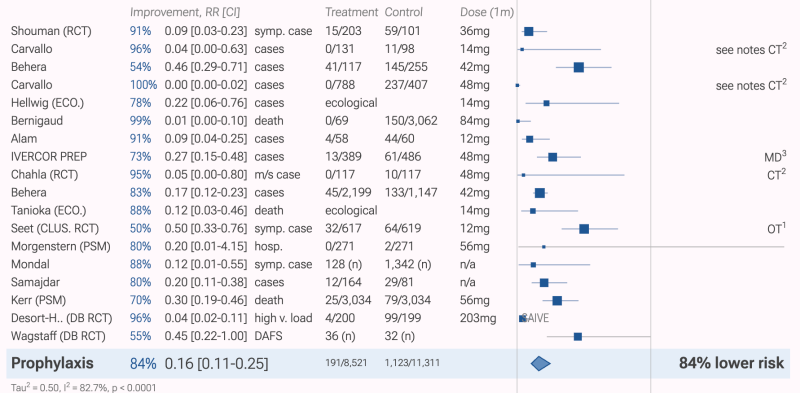
But let's get to the heart of the matter. Today, August 2026, there are 106 studies with clinical results on ivermectin in Covid. And among pre-exposure, when you take it to prevent contagion, or post-exposure, when you take it after having contact with an infected person to try to avoid the disease, there are 18 studies. And absolutely all of the prophylaxis studies are positive. Every single one.
This is the complete table with the full list. In the leftmost column, the name of the lead researcher. Some have the endpoint of infection, others of hospitalization reduction, others of mortality reduction. In the rightmost column, there is a vertical line. It represents the null effect. All the "squares" are to the left of this vertical line. All of them, therefore, indicating efficacy.
The interesting detail. Five of the 18 prophylaxis studies are "gold standard." These are the ones with the acronym (RCT) in parentheses next to the lead researcher's name.
RCT clinical trials are the highest level of scientific evidence for clinical trials. In other words, if you remove all the observational studies and leave only the randomized ones, they all remain positive.
Extra note on ivermectin: this list above is of prophylaxis studies. In the total sum of studies, even when considering only RCT "gold standard" studies, ivermectin is also very effective in outpatient treatment, with a 55% risk reduction. Furthermore, it is effective when treatment is started in already hospitalized patients, with a 29% risk reduction.
The rhetorical trick
Do you see Frankito's trick? First, it was the choice of which of the drugs that became a joke to attack. He chose ivermectin. After all, after Oxford, it becomes difficult to keep the joke going with HCQ. Next, among the ivermectin studies, he chose the easiest endpoint to attack from the lowest-evidence study, the one from Itajaí. All of this crowned with a pretense that the other 17 studies do not exist, including five "gold standard" ones.
In the headline, we read: "False miracle of ivermectin," in bold letters. All of this, on the cover of one of Brazil's largest newspapers.
The Spirit of the Times
In German, there is a very interesting word. It is called "zeitgeist," which in translation would be "spirit of the times" or "spirit of an era." The concept of Zeitgeist helps us understand why so many ordinary people, in a given period of time within a certain historical or social context, behave in a certain way without necessarily considering themselves irrational.
The pandemic was a historical period and had its own "zeitgeist." But before exemplifying the pandemic's "spirit of the times," let me explain this social concept with another recent historical period. The year was 2015 or 2016. Brazil was experiencing political upheaval with large protests in the streets. Everything culminated in a parliamentary coup against elected President Dilma Rousseff. I positioned myself, on social media, against the impeachment. In a presidential system, impeachments are traumatic fractures in democracy. There were two years of government left, and nothing led by deputies like Eduardo Cunha, who was soon arrested, could result in anything good.
One day, a few weeks before the impeachment, I was at a musical event. A person I had known since I was a teenager, but with whom I had no close ties for decades, felt morally authorized to come up to me and start insulting and yelling at me for my stance against the impeachment. It nearly came to punches and kicks. Also, during that same historical period, I went to lunch at a restaurant owned by a friend who identifies with the political right. This friend, the restaurant owner, told a man what my political position was. This guy, whom I had never seen in my life, got up, came to my table, and felt entitled to start yelling at me.
That is what happens when the spirit of an era grants moral permission for people to abandon certain rules of coexistence and thought. And this also happened during Covid-19.
During the pandemic, when anyone tried to draw attention to the emerging evidence on ivermectin or hydroxychloroquine, a huge portion of the population felt morally authorized to laugh at whoever touched on the subject, interrupt people's speech, insult them, or treat them as crazy.
The Zeitgeist does not determine what each individual thinks. It determines, to some extent, what a society considers permissible to think, say, and do. As a reflection, the general thinking went something like this: "This subject is ridiculous. These people are denialists." And therefore, "I am authorized to treat them as ridiculous." The Zeitgeist does not need to convince a society that a certain person is wrong. It just needs to convince it that that person does not deserve to be heard and that this is the smartest thing to do.
During the pandemic, I lost many friends to such behavior, even with my curiosity to watch up close how normal people reacted to this Zeitgeist. For months, when I tried to explain data from emerging studies, their characteristics, both of treatments and vaccines, these people thought they could interrupt, raise their voices, and treat with mockery. For months I remained patient, waiting to see when these people's emotions would return to normal so we could have productive dialogues, but for many, it lasted beyond what was bearable.
The frightening part is that these were not necessarily stupid people. They were people embedded in an environment that said, "It is not necessary to investigate this." In the pandemic's Zeitgeist, society created an environment in which people did not want to, and felt they did not need to, know about the possibilities of studies and where the evidence was pointing.
And even more frightening is that this happened even to specialists. Let me tell a story. I have a friend, a physician, PhD, cardiovascular surgeon, a high-level medical professor. He decided to follow detail by detail the studies that came out, with a critical eye. His mother is also a physician, PhD, medical professor. He tried to show his mother the studies and data that came out so they could discuss what was worthwhile and what was not.
The mother began to treat her son with mockery and as if he were crazy. "So explain to me what is wrong with my interpretation," he asked her, he told me. The mother interrupted him. "If you explain to me why my interpretation is wrong, I will change my mind," he insisted. There was no dialogue. There was mockery and moral accusations. "We were trained exactly to get into the details," he insisted. Their relationship was strained for over two years. Can you imagine the weight of that?
She felt morally authorized to treat her son that way. And today, there it is, as a contrast, reported that hydroxychloroquine is effective, at the highest level of scientific evidence, at the university that is the reference for critical thinking and the cradle of science.
Imagining a brutally honest man
Now imagine a brutally honest man reflecting on his own participation in this Zeitgeist. Not necessarily Frankito. Anyone who has done this—like so many journalists, PhDs, or influencers who made it their life's mission to steer people away from hydroxychloroquine and ivermectin using whatever rhetorical means possible:
"I went along with it and made jokes about it. I called everyone flat-Earthers, science deniers, just because there wasn't maximum evidence yet. But there was always evidence for HCQ and IVM. It was worth looking into. Now we have the highest level of evidence, even from Oxford. I should have understood that the path was leading there, but I didn't. I was incompetent. I put all my effort into steering people away from valid treatments when it was worthwhile.
I didn't just make a mistake. I enjoyed being authorized to treat others like idiots. I enjoyed being in a society that created a collective permission for certain people to be treated as morally illegitimate.
And I don't know how many people died because of my opinions. But I know I had no right to speak with the certainty with which I spoke.
And because of my position, many, many people listened to me. I lost relatives to Covid-19 while treatments were always available. Friends lost their parents.
Only one thing remains for me to do: I promise never to give an opinion on anything again. Nothing that matters. Never again. My wrong bets cost too dearly. From now on, I will only express an opinion if I want pepperoni or margherita pizza.
My opinions, delivered with an air of absolute certainty, while mocking and helping to defame those who were saving lives, led who knows how many people to cemeteries. I contributed to that.
I am going to visit, one by one, the graves of friends' parents, of relatives, who could be alive right now."
It's impossible to be honest
It is impossible for a human being to be so brutally honest. To do so is to erase oneself as a person. It is to sink into deep sorrow. It is an emotional collapse. What remains for them is to keep deceiving themselves, cherry-picking endpoints from the weakest studies, claiming victory, pretending that the monumental body of evidence does not exist, pretending that Oxford did not report what it reported. Others, who took similar positions of mockery and moral righteousness—a stance that crumbles when confronted with the data and facts—also find utility in texts like these: they find the same comfort of self-preservation.
Diogenes, among those who presumed to opine with the airs of sages and analysts during the pandemic, positioning themselves as "defenders of science," but merely reproducing the lobbying of large corporations and steering people away from valid treatments—Diogenes would point his lantern and find empty faces.
Two thousand years later, nothing has changed. However, the question today is probably a different one: what happens to a society when no one can admit they were wrong anymore?
What Would a Brutally Honest Man Look Like?
by Filipe Rafaeli at Brownstone Institute - Economics, Policy, Public Health, Education, Society
Original Author: Filipe Rafaeli | Source: Brownstone Institute
 527.962 SRY